


Results 1,221 to 1,230 of 2022
Thread: Âu
-
02-05-2021, 09:17 PM #1221Biệt Thự


- Join Date
- Sep 2011
- Posts
- 27,513
It’s a serious problem
Ở đâu Châu Âu cũng vậy thôi. Phải cố gắng chịu đựng. Chỉ có bọn nhóc là sướng, "cúp cua đường chánh thức". Khỏi đi học vẫn lên lớp , không phải đổi tên, không cần xé phách bài thi, không cần sợ hổng thuộc bài và không sợ lưu ban.
 Puck Futin
-
02-07-2021, 08:53 PM #1222Biệt Thự
- Join Date
- Sep 2011
- Posts
- 27,513
Heavy snowfall paralyzes northern and central Germany
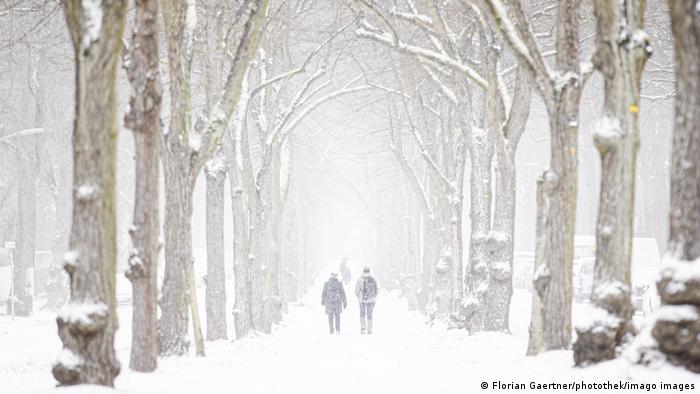
Germany's central and northern areas have been hit hard by heavy snow and winter storms. Rail and road traffic in large parts of the country have been disrupted, and some Bundesliga football matches have been canceled.
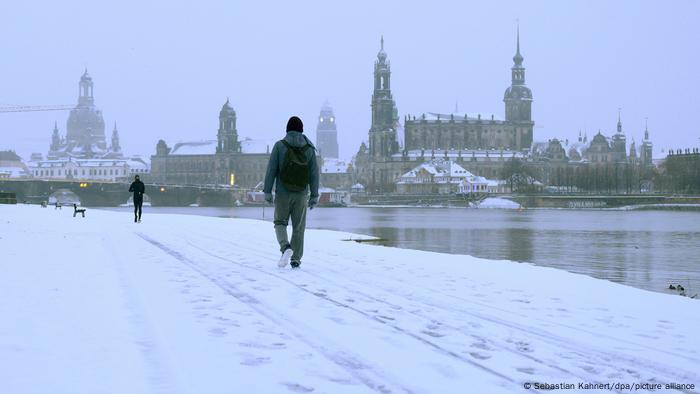
German weather forecasters on Sunday said that the snowstorm is set to bring even lower temperatures in the coming week, as several parts of Germany were hit by extreme winter weather at the weekend.
DWD, the German Weather Service, had issued an extreme weather warning, saying emergency crews had been put on standby.
DWD spoke of an "extraordinary onset of winter."
The snowstorm has affected northern central parts of Germany the most, with dense snow drifts, causing limited visibility, the DWD said.
Local media reported dozens of injuries and traffic accidents around Germany.
DW correspondent Jared Reed said the streets of Hanover in Lower Saxony appear to be empty. "There aren't many people braving the snow," Reed said.
Several states in Germany have been covered with more than 20 centimeters of snow, with winds as strong as 80 kilometers per hour.
The DWD forecasts more snowfall on Monday, and up to 40 centimeters of snow covering some parts in Germany.
Traffic, football matches disrupted
Deutsche Bahn (DB), Germany's train operator, canceled several routes around the country, and has offered refunds in the affected regions.
"Due to snow in some parts of Germany, @DB_Presse @DB_Bahn is offering refunds for anyone who wants this weekend for affected regions," DW correspondent William Noah Glucroft wrote on Twitter.
Train connections with the Netherlands were suspended, and passengers said getting out of Berlin or Hamburg was particularly difficult, with many long-distance train journeys impossible due to heavy snow.
Rail links were also cancelled between Hamburg and Hanover, and Hamburg and North Rhine Westphalia, and the fast inter-city train from Bremen to Norddeich Mole was one of several long-distance connections in northern Germany that have been cancelled by Deutsche Bahn.
Police closed numerous slippery motorways as hundreds of accidents have been reported. In some places, cars were stuck in snowdrifts and buses came to a standstill.
Authorities said a total of 222 car accidents had been registered since Saturday across the western state of North Rhine-Westphalia.
The Bundesliga game between Arminia Bielefeld and Werder Bremen was called off hours before kickoff on Sunday due to a heavy snowstorm.
"Due to the heavy and prolonged snowfall combined with frost, it's not guaranteed that the game can be carried out properly,'' the German Football League (DFL) said in statement. "A new date for the game will be announced shortly.''
The second-division game between Paderborn and Heidenheim was also called off.
Extreme weather to persist
Arctic weather patterns in the north led the DWD to issue its highest warnings for parts of North Rhine-Westphalia, Lower Saxony and Saxony-Anhalt on Saturday.
In Berlin, authorities opened more emergency homeless shelters ahead of the expected cold snap.
Black ice was forecast for parts of North Rhine-Westphalia, Hesse, Rhineland-Palatinate, Thuringia and Saxony.
Officials said southern Germany would see milder weather owing to low pressure over western Europe.
There were warnings of severe storms, gales and gusting winds near the Alps.
German federal police said people had largely complied with warnings for Saturday and avoided popular tourist destinations.
fb,jf, shs/ng (dpa, AP)
/* src.: https://www.dw.com/en/heavy-snowfall...any/a-56483641
Puck Futin
-
02-07-2021, 09:02 PM #1223Biệt Thự
- Join Date
- Sep 2011
- Posts
- 27,513
bầu niệm.
Switzerland marks 50 years of women voting
Switzerland is celebrating the 50th anniversary of giving women the right to vote. But why was the country so late — and where does it stand today? DW spoke to two feminist experts in search for answers.

One of the largest and most significant protests took place in Berne in 1969
"For a long time, it was a part of the Swiss identity, that we are an ancient democracy. But this means that we are accepting, that only because men said that we are a democracy, we must be. This idea is gone now," says Zita Küng, one of the most influential Swiss feminist activists.
The myth that Switzerland is one of the oldest democracies in the world dates back to the Middle Ages, when men, even of lower status, enjoyed the freedom to meet at a yearly assembly and vote directly on various issues by raising their hand or their weapon.
The tradition lasted for centuries. But one crucial part was missing in this country that prides itself on its model of direct democracy — the female hand.
Discrimination sealed in the constitution
Women were largely absent from Switzerland's political life until 1971. It was one of the last countries in Europe to grant women the right to vote. Women in Finland were the first to be granted the right to vote in 1906, and in Germany women have been casting their ballots since 1918. What took Switzerland so long?
The simple answer is a lack of political will. "It was not the government. It was not parliament. It was the Swiss people, the men who were in a position to decide," Küng told DW.
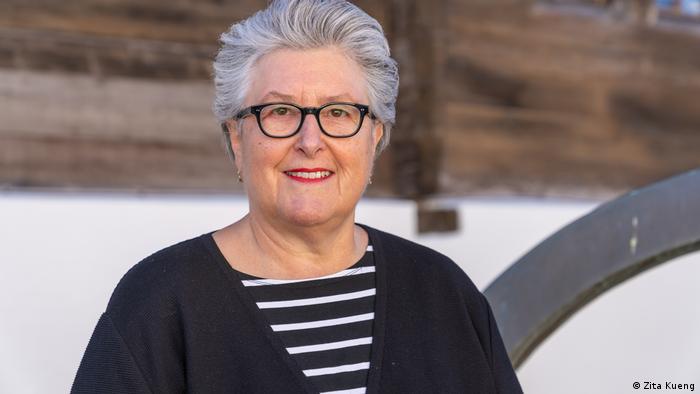
Zita Küng is one of Switzerland's most influential feminist activists
Küng, a 67-year old feminist activist, was born into a working class family in Zurich and was the first in her family to go to university. A teacher, singer and jurist, she was interested in women's issues from a young age. Küng was the co-founder of the Organization for the Cause of Women, one of the most important organizations of the women's movement. Today, she teaches at the "feminist faculty," which she co-founded and which offers seminars and workshops on equality.
She told DW that women needed a majority of Swiss men to accept a woman's right to vote. Their initial unwillingness to share their power with women had, however, deeper roots in Swiss conservative tradition.
Isabel Rohner, an expert on feminist issues and co-author of the book 50 Years of Women's Suffrage, said that traditionally Switzerland, similar to other countries, was based on a patriarchal system, in which public and private spheres were strictly separated. Politics and the military were a man's domain, whereas taking care of the household and family was the responsibility of women.
Moreover, the old Swiss constitution from 1848 granted only men the right to vote and didn't recognize women as part of public life. Rohner thinks the way the constitution was written was undemocratic.
"You can't talk about democracy when you're talking about a society where more than 50% are excluded from political participation and from legislation. Before 1971, the laws were made without taking women's interests into account, and in many cases, these laws were against women's interests," she said.
Louder voice of a new generation
In the 1960s, the suffragette movement started gaining traction. Change was slow and started on a local, cantonal level. Several cantons began allowing women to participate in politics, but many others were still strongly against it.
Several factors then influenced a historic change of the constitution. Globally, there was a climate of change, exemplified by the protests against the Vietnam War that were raging across the United States as well as the civil rights movement for Black Americans and the nascent environmental movement.
The sexual and cultural youth revolution was breaking the old social norms in search of the new way of life. In the late 1960s, Switzerland wasn't immune to those changes.
"There is a difference between rural areas and cities in Switzerland. The people in the cities were quite influenced by all those international movements," said Rohner.
On a European level, Switzerland was among few countries left where women were still not able to vote, along with Liechtenstein and Portugal.
"Switzerland had more and more the problem of reputation because it was really embarrassing that Switzerland, which, as we always hear was one of the oldest democracies, didn't have women's suffrage," said Rohner.
And in the final years before the constitutional change, Switzerland was involved in formulating the European Convention on Human Rights. One of the preconditions was to grant women the right to vote, which was yet again denied by Swiss men.
This led to widespread protests in 1969, during which several thousand women gathered in the famous March on Berne.
"Women got up and made a big manifestation in Berne and that was the final event that showed men that this is a serious case. You will not escape anymore," said Küng.
"They were willing to show up, to be loud, and show that they were really angry," said Rohner. She added that the new generation of women suffragettes were louder and more radical in their decision to change the minds of Swiss men.
In 1971 they finally succeeded. In a historic referendum, the majority of Swiss men granted their wives, daughters, sisters and mothers the right to vote at the federal level. The last conservative stronghold was the small canton of Appenzell Innerrhoden, where men refused to concede until they were forced by the Federal Court to grant women the right to vote in 1991.
Long road to civil liberties
But for Zita Küng, getting the right to vote was just the beginning.
"Of course, political rights are important, but we needed to speak about abortion, we needed to speak about birth control, about how we live, about education. We needed to speak about the economic situation of women, about children. We needed to speak about justice, about violence, about changing the social development, and this was the feminist movement I was a part of in Switzerland," she said.
Küng was active in campaigns where women fought to change the controversial marriage law, under which married women weren't allowed to have their own bank account, had to ask their husbands for permission to work or sign contracts and documents, and were not able to choose where they could live. Rohner called the law "a form of slavery, where married women lost their civil rights."
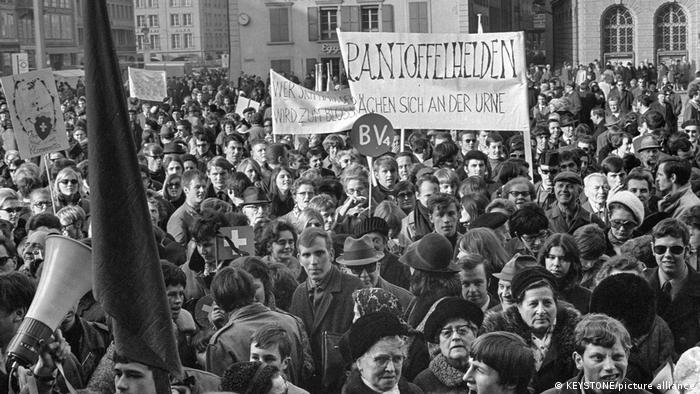
In 1969, thousands of women gathered to demand the women's right to vote
The new marriage law that granted women an equal marital status is seen as one of the key milestones in the historical fight for women's rights. The movement, with Küng at the forefront, then worked on initiatives for the right to abortion in the first 12 weeks of pregnancy, and access to birth control pills without prescription. The fact that women were allowed to vote enabled them to vote in favor of other civil rights.
The fight continues
What about women in Switzerland today, 50 years later? In 2019, hundreds of thousands of Swiss women inspired by the new #MeToo movement took to the streets to protest gender inequalities, such as the gender pay gap, unpaid household work and lack of government representation. Although the women's rights movement had major historical successes in many political and civil aspects, Switzerland was still lagging behind many European neighbors when it came to gender equality.
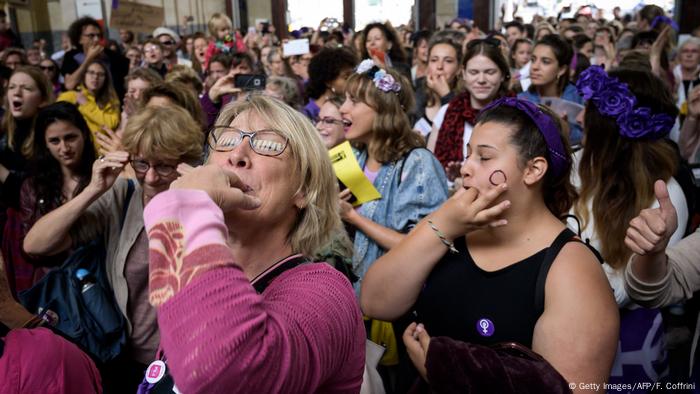
Swiss women protested for gender equality in 2019 in Lausanne
Today, for Küng, old-age poverty in women is one of the biggest concerns.
"It's just a scandal that a country like rich Switzerland condones that when women get old, that they actually have to receive social assistance", she said.
Another significant issue is sexual violence against women.
"This is basically a cultural question and the paradigm has to be changed. We have to stop talking about women fighting back, we have to start talking about men renouncing violence. It must become clear, even in the upbringing of the boys that a good boy is one who does not use violence," she said.
She pointed out that the coronavirus pandemic has been far more demanding for women than it has been for men. Women traditionally not only work but take care of the household as well. Working from home while homeschooling adds to the pressure. Nursing jobs, which are essential in a pandemic, are traditionally also women's jobs — and still poorly paid in Switzerland.
Rohner said Switzerland still has "structural inequality in nearly every sector in politics, in the economy and in society as a whole."
But the expert said Switzerland is also an example that positive change is possible. In the last several years, female representation in politics has significantly increased to 42%, a higher percentage than in Germany. The gender pay gap, though still high at 8%, has also reduced over the years.
For Rohner, 50 years of women's right to vote in Switzerland is a big anniversary and a good moment to reflect on "50 years of Swiss democracy" and the importance of political participation.
"1971 was the beginning of the chance to build an equal society," she said. "It's not the end of a process, it's the beginning."
/*src.: https://www.dw.com/en/switzerland-ma...ing/a-56469446
Puck Futin
-
02-08-2021, 02:04 PM #1224Banana ArtBook

- Join Date
- Sep 2011
- Location
- Ốcland
- Posts
- 10,531
Businexit:
Yorkshire lobster exporter says Brexit costs have forced it to close
https://www.theguardian.com/politics...s-forced-close
Industry experts said that Baron Shellfish, the first lobster-tank business in Europe’s largest shellfish port, appears to be the first big exporter to have announced its closure.
Speaking from Bridlington on Monday, where he is in the process of dismantling hundreds of lobster crates, Baron said: “All we have had is bullshit from the government, promises that haven’t been kept. I am winding up the business while I still have enough to pay redundancy to my staff.
“People say Boris has tried his best, but it just hasn’t been enough,” he said. “It’s the extra costs and uncertainty. We have to fill in new health notes, and there is a lot of new paperwork, including the catch certificates. Every time you put lobsters on transport, if anything in the paperwork is wrong, you have lost everything.
“It is all Brexit-related – the extra costs, extra paperwork and the extra gamble – and it is down to the government and the EU. Every time you send out transport with lobster, it is like playing Russian roulette with five bullets in your gun.”
While inside the common market, Baron’s company bought lobsters from businesses in Bridlington and sold to countries including Spain, Belgium and Italy. He has exported up to five tonnes of lobster a week to mainland Europe.
Baron, 58, who voted to remain but came round to the idea of leaving the EU, is planning to pay off three members of staff and sell his crates and vehicles. “I voted to stay in because I was worried about the business. But I wish we had never gone into the EU in the first place,” he said.
Many fishers have been unable to export to the EU since catch certificates, health checks and customs declarations were introduced at the start of this year, delaying their deliveries and prompting European buyers to reject them.
Under longstanding EU rules, catches of live bivalve molluscs such as mussels, oysters, scallops, cockles and clams from non-EU member states can only be imported without treatment if they come from waters deemed of the highest quality. These rules have closed off many exports of live bivalve molluscs from the UK since Brexit took full effect.
Chắc Âu châu phải ăn đỡ tôm tích Phú quốc.
- tôm tích: từ chữ MANTIS (shrimp)
-
02-09-2021, 07:59 PM #1225Biệt Thự
- Join Date
- Sep 2011
- Posts
- 27,513
 Originally Posted by ốc

Nước Châu Âu toàn là phó giả không hà, không phải trưởng giả nên đâu có học ăn tôm. Puck Futin
-
02-09-2021, 08:03 PM #1226Biệt Thự
- Join Date
- Sep 2011
- Posts
- 27,513
Flockdown.
Hãy rơi như chưa rơi lần nào.
Major snowstorm hits Europe, U.K. as temperatures plummet
It was the first significant snowstorm in the Netherlands in 10 years

A person well wrapped up against the cold weather walks through the snow in Berlin's Kreuzberg district Monday. (David Gannon/AFP/Getty Images)
By
Matthew Cappucci
Feb. 8, 2021 at 5:33 p.m. GMT+1
Parts of Europe and the United Kingdom are digging out after a significant snowstorm dropped up to 15 inches of snow in areas unaccustomed to the weather hazard, grinding travel to a halt and disrupting coronavirus testing sites. Plummeting temperatures will accompany the “Beast from the East,” freezing canals as the mercury dips some 20 degrees below average for this time of the year.
Continued snow will affect parts of the United Kingdom, where the Met Office has warned that “there is a good chance that some rural communities could become cut off.” Amber warnings were in effect for areas northwest of Edinburgh, while yellow warnings blanket the entire east coast of the U.K.; that’s where additional accumulating snow was likely Monday and Tuesday.
Heavy snow fell this weekend in far southeastern England, as cold winds carried moisture inland from the North Sea.
Meanwhile, significant snow is likely throughout the week in Eastern Europe, with double-digit totals possible in eastern Poland, southern Belarus and Ukraine.

Heavy snow in southeast England and Scotland over the weekend kick-started a week of freezing temperatures across many parts of the United Kingdom. (Dan Kitwood/Getty Images)
The wintry weather began over the weekend when a series of low-pressure systems began moving east across western Europe. The repeated storm systems drew cold air down from the northeast while also transporting moisture from the south, contributing to hefty snow totals. The first system, dubbed “Storm Darcy” by weather officials in the Netherlands, is paving the way for additional snowfall.
Dutch officials began naming storms last year in a recently codified partnership with the U.K. Met Office and Ireland’s Met Éireann.
Conditions deteriorated late Saturday and raged Sunday in Europe, where winds reportedly gusted up to 55 mph. The Dutch Meteorological Institute even hoisted red weather warnings, urging residents of the Netherlands to stay off roadways.
According to Euronews, it’s the first significant snowstorm to hit the Netherlands in a decade. The Guardian reports that all train service was suspended during the height of the storm, with numerous flights out of Amsterdam canceled as well.
In adjacent Germany, at least a foot of snow fell in western parts of the country through Sunday morning, with drifts up to three feet. Hundreds of car accidents were reported.
Precipitation began as rain in the United Kingdom late Saturday, flipping to snow as the atmosphere cooled. Several inches accumulated in Kent, just southeast of London, where snow is unusual. Totals in the four-inch range were evident in Canterbury, about 10 miles inland from the English Channel.
Elsewhere in Europe, southerly winds ahead of Darcy transported a blanket of Saharan dust north to the Swiss Alps, causing the snow to turn a dusty, reddish-brown.
By late Monday, Darcy was translating eastward through Eastern Europe, where it could drop as much as a foot of snow in Ukraine. Behind it trailed secondary and tertiary low-pressure systems, which will conspire to reinforce the presence of cold air over Europe.

Deer grazing in the snow in Knole Park in Sevenoaks, Kent, Britain, on Monday. (Facundo Arrizabalaga/EPE-EFE/REX/Shutterstock)
The tempestuous trio was organizing a conveyor belt of frigid air from Russia that will team up with Arctic high pressure building in by the weekend.
That onshore flow will bring renewed snow to the United Kingdom, while also pouring frigid air over central and Eastern Europe. The coldest air will stretch from the Netherlands and Germany east to Poland, where temperatures could remain below freezing for the next 10 days. Highs will sit 15 to 20 degrees below average.
The prime minister of the Netherlands has promised that, if canals freeze, ice skating will be permitted — so long as residents obey social distancing protocols.
Below-average temperatures look to persist across much of Europe through at least mid to late February, part of the same chain of events bringing bitter cold to much of the North Central United States.
A disrupted polar vortex is allowing cold to spill out of high latitudes across the Arctic, sending lobes of frigid cold south into Europe, Asia and North America.
/* src.: https://www.washingtonpost.com/weath...urope-uk-cold/
Puck Futin
-
02-09-2021, 08:07 PM #1227Biệt Thự
- Join Date
- Sep 2011
- Posts
- 27,513
Tháng Hai Châu Âu: (Tuyết) Hãy rơi như chưa rơi lần nào.
Puck Futin
-
02-09-2021, 08:19 PM #1228Biệt Thự
- Join Date
- Sep 2011
- Posts
- 27,513
Winter weather causes chaos in Europe
Puck Futin
-
02-09-2021, 08:25 PM #1229Biệt Thự
- Join Date
- Sep 2011
- Posts
- 27,513
No way forward, no way back: the nightmare of migrants trapped in Bosnia
Puck Futin
-
02-11-2021, 08:31 PM #1230Biệt Thự
- Join Date
- Sep 2011
- Posts
- 27,513
Puck Futin

 Reply With Quote